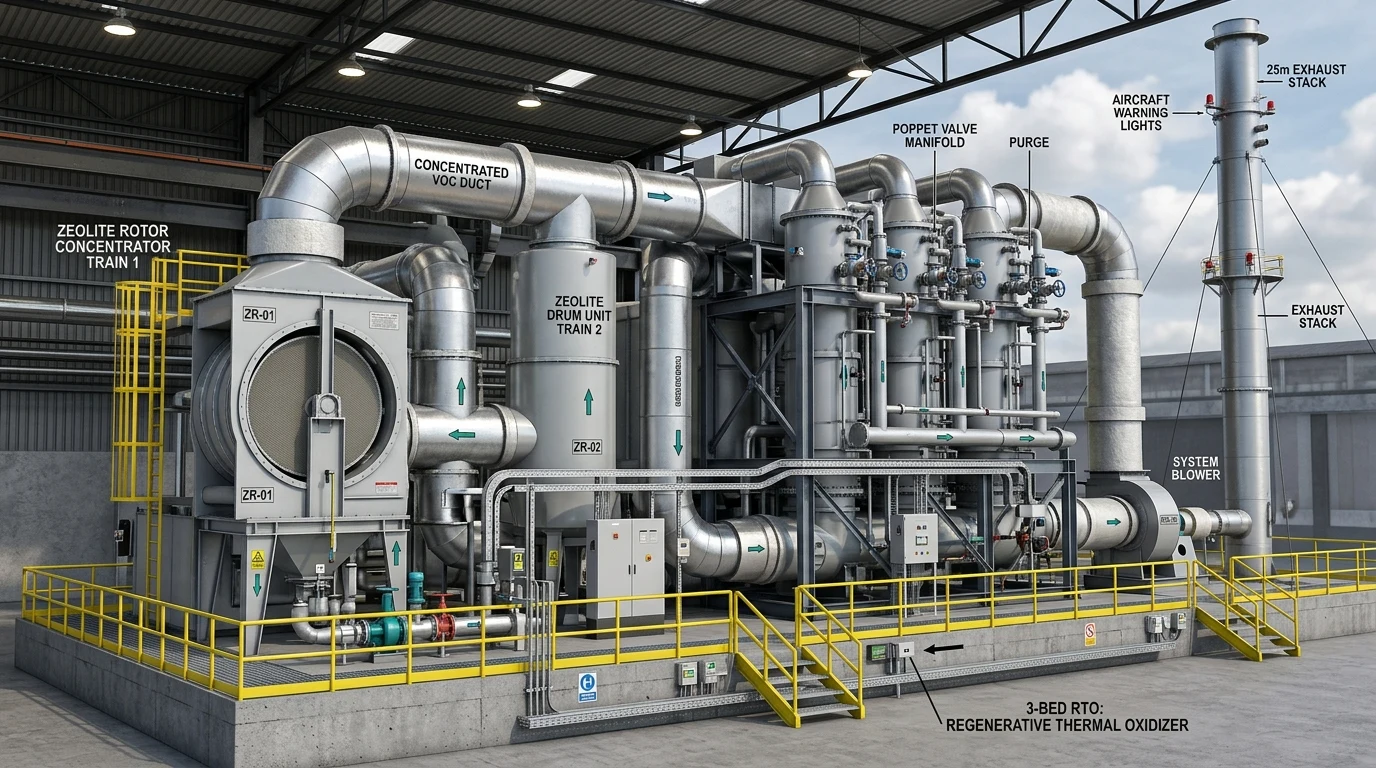
60,000 m³/h Dual Zeolite Rotor/Drum & 3-Bed RTO Abatement System
Wuhan Guangjia Automotive Interior Trim Co., Ltd. | Robotic Coating, Water Transfer Printing & UV/PU Finishing Lines
Dual Solvent Streams Mastered by Monolithic Rotor, Cylindrical Drum & 3-Bed RTO
Wuhan Guangjia Automotive Interior Trim Co., Ltd., established in 2010 in "China's Motor City" — the Wuhan Economic and Technological Development Zone — is an elite Tier-1 automotive component manufacturer with over 800 employees. As an authoritative supplier of precision interior assemblies, cockpit trims, and exterior components to premier global automotive OEMs including Dongfeng Honda, Dongfeng Nissan, General Motors, and leading EV manufacturers, Wuhan Guangjia operates high-precision automated coating, water transfer printing, UV curable finishing, and thermal curing facilities.
To address plant boundary odor sensitivity, comply with increasingly stringent Hubei provincial environmental regulations, and achieve Grade-A Environmental Performance Certification, Wuhan Guangjia contracted FluxFine to deliver a comprehensive, turnkey EPC emission abatement facility. The project demanded treating an aggregate process airflow of 60,000 m³/h (35,300 CFM) characterized by two distinctly challenging chemical profiles: high-volume dilute solvent streams (40,000 m³/h containing butyl acetate, MIBK, and PGMEA) from primer and basecoat lines, and high-boiling solvent exhaust (20,000 m³/h carrying diethylene glycol monobutyl ether acetate alongside reactive UV acrylic monomers) from automated UV and PU lines.
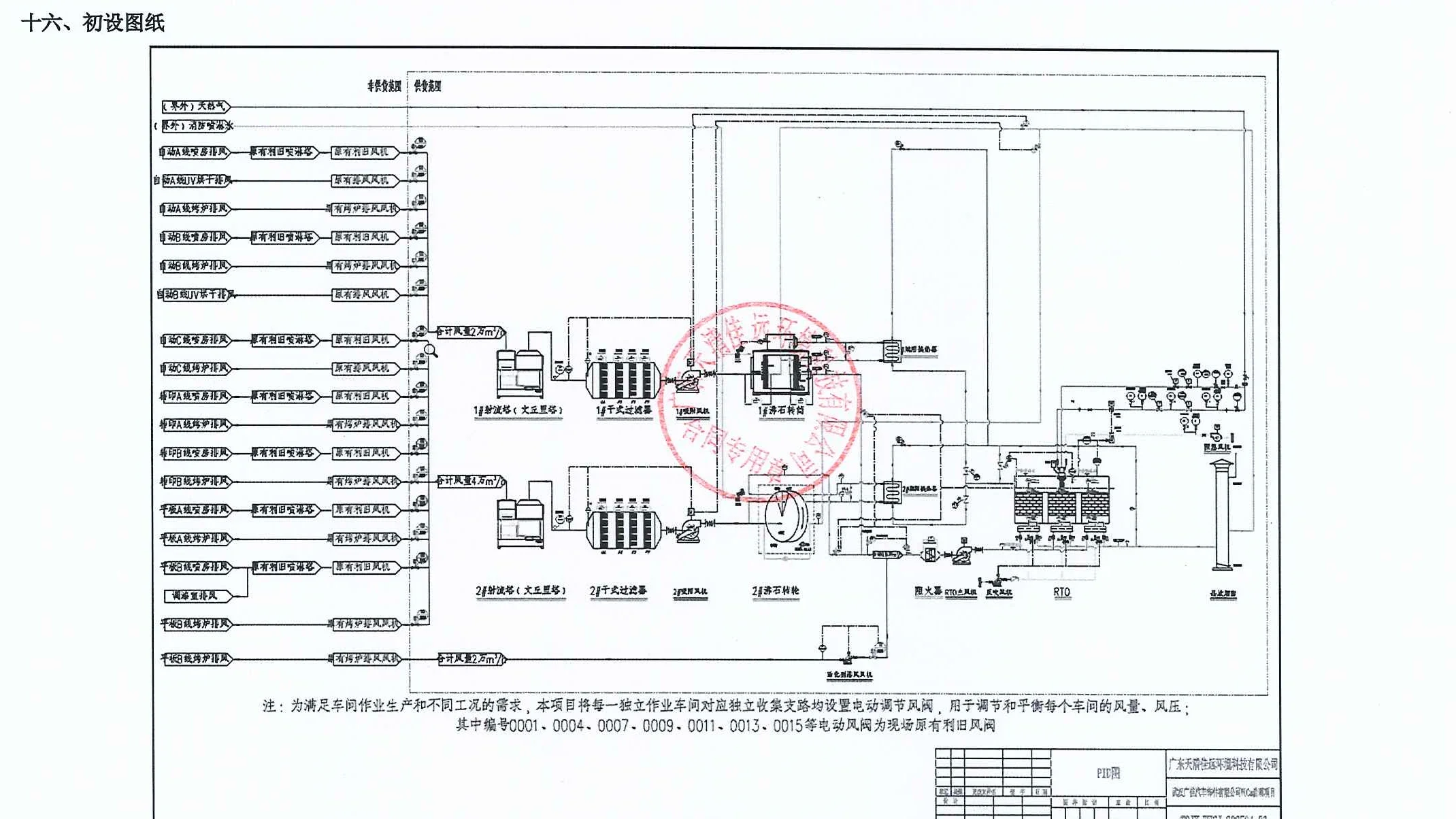
FluxFine engineered a decoupled dual-train molecular sieve architecture: a 40,000 m³/h Monolithic Disk Zeolite Rotor paired with a 20,000 m³/h High-Temperature Cylindrical Zeolite Drum, both converging into a central 8,000 Nm³/h Three-Bed Regenerative Thermal Oxidizer (3-Bed RTO). Integrated with dual fluid-kinetic jet mixing venturi scrubbers, four-stage differential-pressure-monitored dry filters, and closed-loop desorption heat recycling, the installation guarantees ≥99.0% overall VOC Destruction and Removal Efficiency (DRE), suppresses stack emissions to NMHC < 20 mg/m³, and sustains near-complete autothermal operation with minimal auxiliary fuel consumption.
Engineered Performance & Guaranteed Compliance
Empirical metrics independently validated during full-capacity automotive interior component manufacturing runs.
Three-bed regenerative thermal oxidation chamber operating at 800°C–820°C delivers continuous destruction across all solvent isomers.
Discharge concentrations remain far below the 30 mg/m³ provincial limit, fulfilling Wuhan Municipal Grade-A benchmark criteria.
Molecular sieve concentration shrinks 60,000 m³/h raw process air into a dense ~4,500–5,000 m³/h desorption stream for compact thermal destruction.
LANTEC multi-channel honeycomb ceramic packing recovers ≥95% of thermal energy, powering self-sustaining oxidation and zeolite desorption.
Four Severe Engineering Hurdles Overcome
Automotive interior component finishing combines high-boiling specialty esters, sticky acrylic aerosols, and fluctuating shift patterns that overwhelm standard air pollution control units.
High-Boiling Solvent Chemistry
UV and PU lines discharge diethylene glycol monobutyl ether acetate (boiling point 245.0°C). Conventional low-temperature zeolite systems suffer heavy ester condensation and coking, requiring specialized 220°C–250°C high-temperature thermal regeneration.
Sticky Acrylic Paint Overspray
Robotic spray booths release fine, gummy paint aerosols (0.1–20 μm) that easily bypass ordinary water curtains. If allowed into molecular sieve wheels, these droplets permanently blind microscopic adsorption pores, destroying capture capacity.
Decoupled Production Schedules
Wuhan Guangjia operates varying shift frequencies: Auto A/B lines at 15 shifts/mo, transfer printing at 6 shifts/mo, flatbed lines at 22 shifts/mo, and Auto C line at 4 shifts/mo. The system demanded independently dispatchable trains without idling losses.
Strict Boundary Odor Caps
Located in Hannan District adjacent to automotive industrial facilities and logistics corridors, the plant enforced strict boundary odor limits (GB 14554-93 < 2,000 dimensionless). Any transient valve switching leak of sweet ketone/acetate odors was prohibited.
Decoupled Dual-Train Molecular Concentration with Central RTO
A multi-barrier treatment train segregating high-volume standard solvents from high-boiling UV streams, converging at an 8,000 Nm³/h thermal oxidizer core.
Dual-Train Solvent Decoupling & Closed-Loop Oxidation
Central 8,000 Nm³/h (4,700 CFM) Three-Bed RTO (3-Bed RTO)
Combines 4,500 m³/h rich desorption streams from Train 1 & Train 2 + 1,000 m³/h direct curing oven flues. LANTEC honeycomb structured ceramic media delivers ≥95% thermal recovery, operating in autothermal balance at 800°C–820°C.
Comprehensive Four-Dimensional Design Matrix
Deterministic boundary parameters, operating conditions, guaranteed emission caps, and thermal balance metrics for the Wuhan Guangjia facility.
| Dimension / Parameter | Design Specification | Operational Value | Guaranteed Outcome |
|---|---|---|---|
| Train 1# Design Airflow | Auto C line, transfer printing, flatbed line, paint mixing | 40,000 m³/h (23,500 CFM) | Design Inlet Conc. ~390 mg/m³ |
| Train 2# Design Airflow | Auto A/B lines (UV & PU coating), activator exhaust, ovens | 20,000 m³/h (11,800 CFM) | Design Inlet Conc. ~160 mg/m³ |
| RTO Thermal Core Sizing | Aggregated desorption streams + direct oven thermal flues | 8,000 Nm³/h (4,700 CFM) | Inlet VOC: 3,361 mg/Nm³ |
| Pretreatment Pressure Drop | Jet kinetic venturi scrubber + 4-stage dry filtration box | Scrubber ≤1,200 Pa • Dry Filter 300–500 Pa | ≥95.0% Particulate Removal |
| Adsorption Removal Efficiency | Hydrophobic aluminosilicate molecular sieve (Disk + Drum) | ≥93.0% Dynamic Adsorption | Drum Stack <11 mg/m³ • Rotor <27 mg/m³ |
| RTO Combustion Chamber Temp | Three-bed refractory lined combustion chamber (Maxon burner) | 800°C – 820°C (Design 816.8°C) | ≥99.0% Destruction DRE |
| Thermal Energy Recovery (TER) | LANTEC multi-channel honeycomb ceramic packing media | ≥95.0% Thermal Efficiency | Stack Temp: Inlet + 40°C–50°C |
| Stack Non-Methane Hydrocarbons | 25m discharge stack (Hubei Provincial / Wuhan municipal cap) | NMHC ≤ 20 mg/m³ | Outperforms 30 mg/m³ Standard |
| Stack Particulate & Odor | Continuous optical CEMS sampling & boundary monitoring | PM ≤ 5 mg/m³ • Odor < 2,000 | Full Grade-A Benchmark Compliance |
Technical Excellence in Automotive Trim Finishing
How FluxFine engineered a decoupled dual-train molecular sieve configuration, fluid-kinetic paint mist capture, and closed-loop thermal oxidation.
Decoupled Dual Molecular Sieve: Disk Rotor + Cylindrical Drum
Automotive interior trim finishing blends standard solvent spray booths with high-temperature UV curable lines. Forcing both streams through a standard monolithic wheel causes irreversible pore fouling from high-boiling solvents (such as diethylene glycol monobutyl ether acetate, boiling point 245°C).
FluxFine decoupled the streams into two dedicated adsorption trains. Standard volatile streams (Auto C and transfer lines, 40,000 m³/h) pass through a monolithic disk zeolite rotor. Concurrently, UV/PU coating lines (20,000 m³/h) pass through a modular radial-flow Cylindrical Zeolite Drum. The drum provides 3× larger filtration surface area, lowers pressure drop to ≤800 Pa (3.2 in. w.g.), and incorporates high-temperature fluoroelastomer seals capable of routine 220°C to 250°C thermal regeneration, completely eliminating heavy ester coking.
Fluid-Kinetic Venturi Scrubbing & 4-Tier Particulate Defense
In robotic automotive interior spray painting, overspray droplets form sticky polymeric aerosols (0.1–20 μm) that rapidly blind zeolite molecular channels. Traditional dry filters alone clog within days when exposed to raw paint mist.
FluxFine implemented a high-energy Jet Mixing Venturi Scrubber ahead of each train. High-velocity gas passing through a constricted venturi throat (Ø400mm and Ø610mm) atomizes recirculating water into micro-droplets, capturing tacky overspray via high-energy inertial impaction. Following cyclonic mist elimination, exhaust passes through a Four-Stage Dry Filtration Box containing G4 coarse → F5 medium → F7 pocket → F9 high-efficiency coalescing tiers. Differential pressure transmitters provide real-time loading feedback across a 300 Pa to 500 Pa (1.2 to 2.0 in. w.g.) operating band, ensuring ≥95% PM capture down to 0.5 μm.
Three-Bed RTO Core with LANTEC Structured Ceramic Media
The concentrated desorption streams from both zeolite units merge with direct curing oven exhausts into an 8,000 Nm³/h Three-Bed Regenerative Thermal Oxidizer (3-Bed RTO). Two-bed RTO systems suffer momentary VOC release during poppet valve switching, preventing compliance with ultra-low emission standards.
FluxFine engineered a true 3-bed configuration (Bed 1: Preheating, Bed 2: Heat Recovery, Bed 3: Zero-Slip Purge). Fast-acting SMC pneumatic poppet valves (switch time ≤1.0s, leakage ≤0.05%) purge unburned residual vapors back into the 816.8°C combustion chamber prior to stack release. Filled with high-efficiency LANTEC multi-channel honeycomb ceramic packing (specific surface area ≥680 m²/m³), the oxidizer delivers ≥95.0% thermal energy recovery, cooling exhaust to within 40°C–50°C of inlet temperatures and achieving continuous autothermal balance.
Rooftop Ductwork Integration & Motorized Pressure Balancing
Connecting multiple independent spray booths, water transfer printing lines, and curing ovens across varying building elevations posed significant duct routing and pressure fluctuation challenges.
FluxFine engineered an integrated galvanized and stainless steel rooftop manifold with motorized balancing dampers across every process branch (valves 0001 through 0015). Modulated by static pressure transmitters linked to the central Siemens PLC, the dampers automatically adjust during production line shift changes, maintaining constant face velocity in active booths while preventing backdraft into idle lines. Clean secondary flue gas heat from the RTO is recirculated via an air-to-air shell-and-tube heat exchanger, supplying 180°C to 220°C desorption air to both the rotor and drum with zero electrical heater load.
Fail-Safe Architecture & Siemens S7-1200 PLC Controls
Comprehensive hardware interlocks, multi-point optical LEL surveillance, and automatic emergency bypass protocols ensuring uncompromised plant safety.
Multi-Point LEL Interlocks
Explosion-proof optical and catalytic LEL detectors continuously sample raw inlet manifolds and high-concentration desorption streams. If VOC concentrations exceed 20% LEL, audible alarms trigger; at 25% LEL, fast-acting pneumatic fresh-air dilution dampers instantly actuate, preventing flammable mixtures from entering the RTO.
Burner & Over-Temp Safety
The Maxon low-NOx burner incorporates double gas safety shutoff solenoid valves, gas high/low pressure switches, and UV optical flame scanners. If combustion chamber temperatures exceed 850°C, high-temperature bypass dump valves open to discharge excess enthalpy; in the event of flameout, fuel gas isolates within 3.0 seconds.
Siemens PLC Supervision
Central automation is governed by a Siemens S7-1200 PLC system with Ethernet/IP distributed I/O and touchscreen HMI. Featuring automated one-button startup, PID combustion temperature modulation, pneumatic valve stroke feedback, and emergency power-loss fail-safe open/close positions.
Equipment in This Project
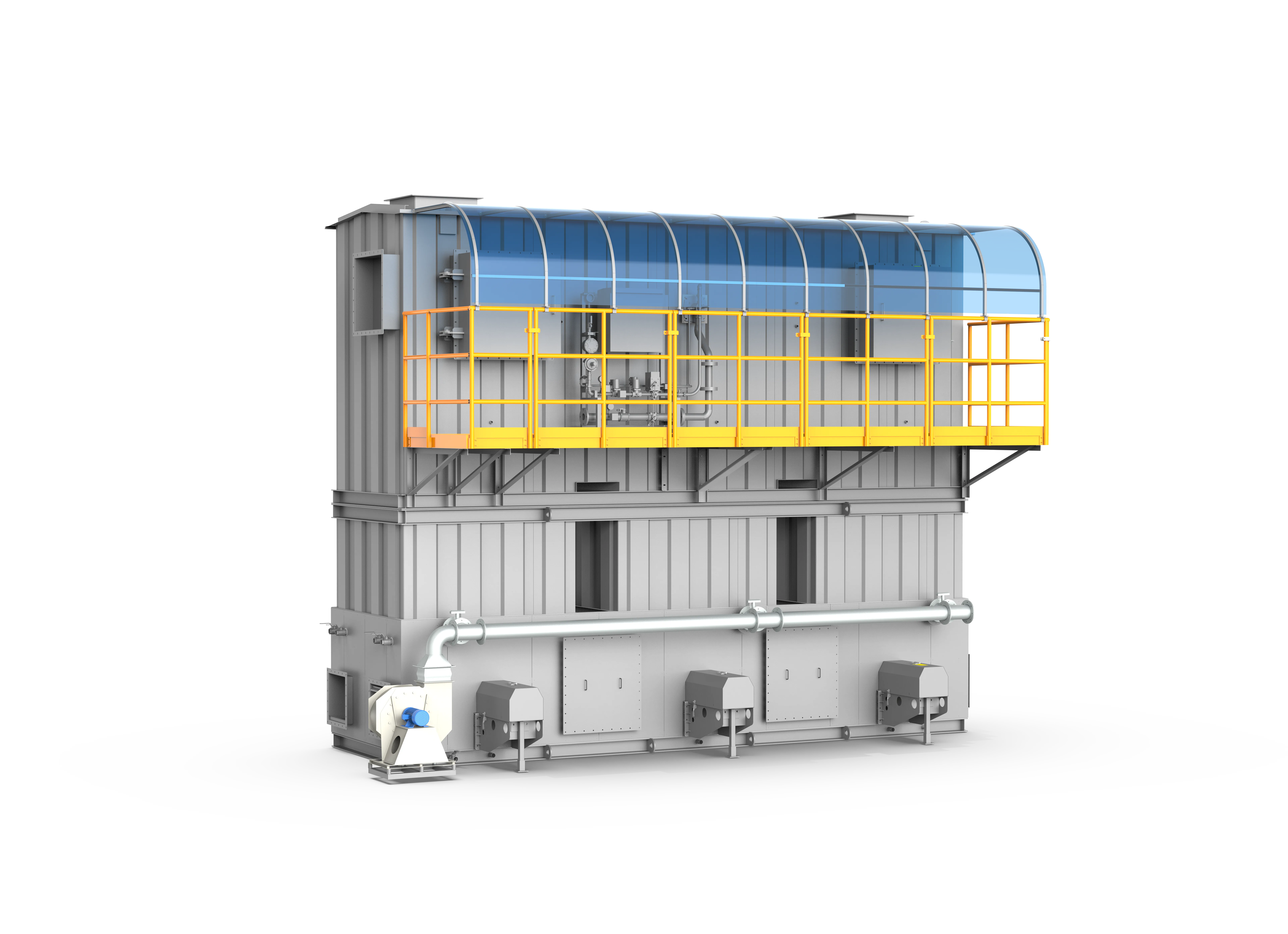
Three-Tower RTO
A premier-grade industrial VOC thermal abatement system that achieves >=99% VOC destruction efficiency and >=95% thermal energy recovery through a classic three-bed alternating heat-exchange and purge process.
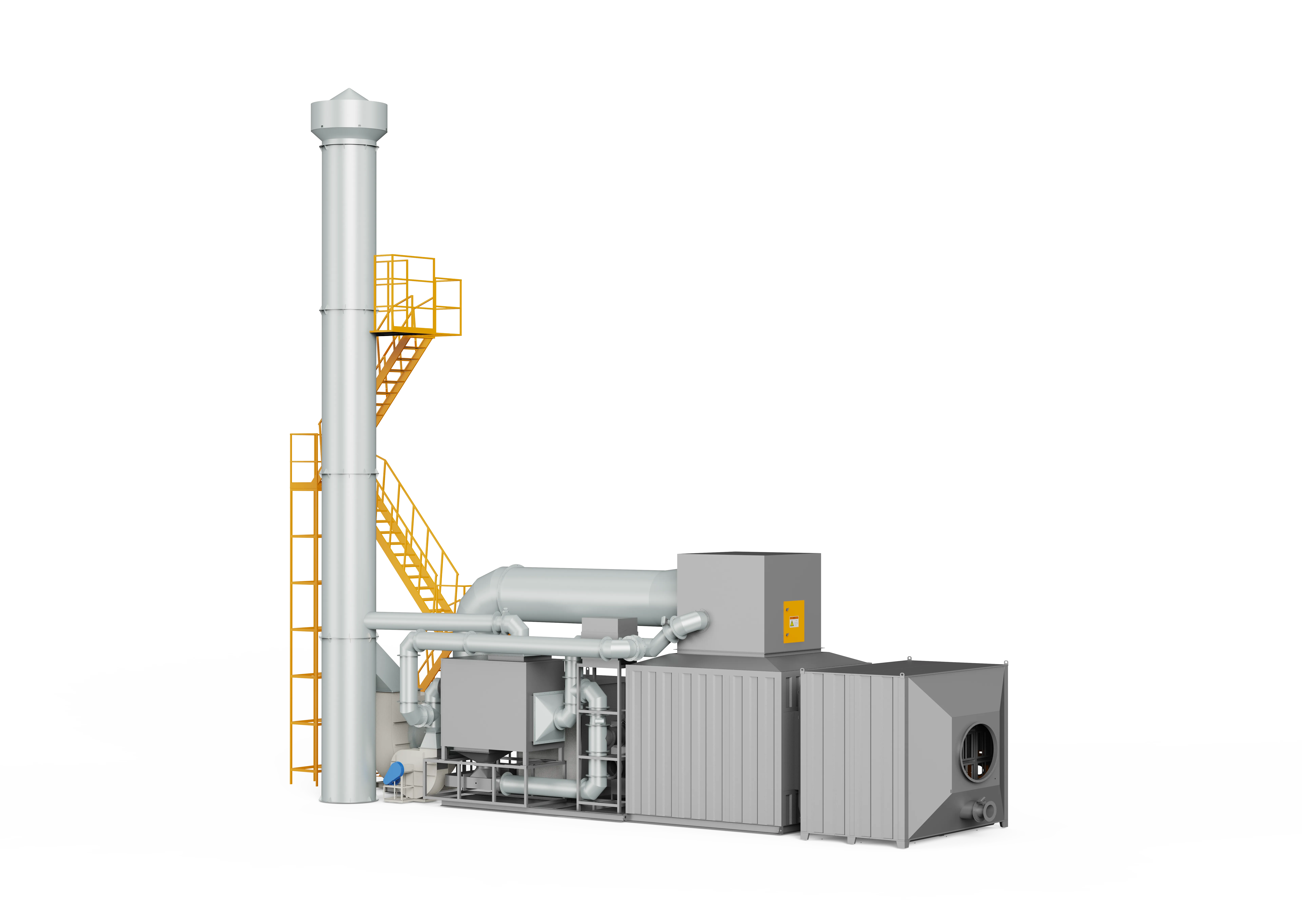
Zeolite Rotor
A high-efficiency VOC pre-treatment and concentration system utilizing advanced hydrophobic zeolite molecular sieves to continuously adsorb, desorb, and enrich large-airflow, low-concentration organic exhaust gases, reducing downstream thermal destruction energy consumption by 40% to over 50%.
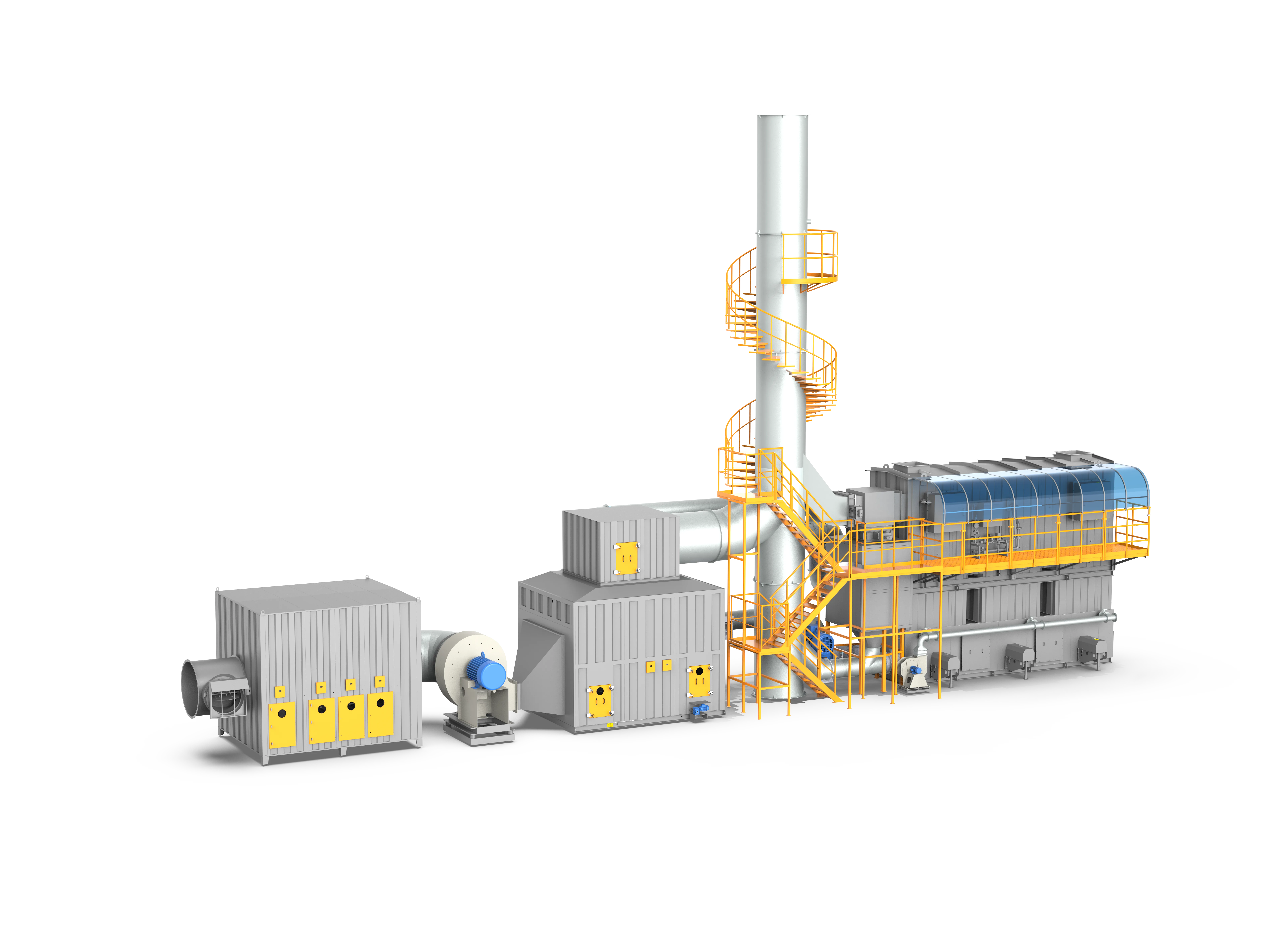
Rotor + 3-Tower RTO
The premier system for large-airflow, low-concentration VOC emissions, combining a hydrophobic zeolite rotor for 10-40x gas enrichment with a mature three-tower RTO for complete destructive oxidation, cutting energy costs by 40%-60%.
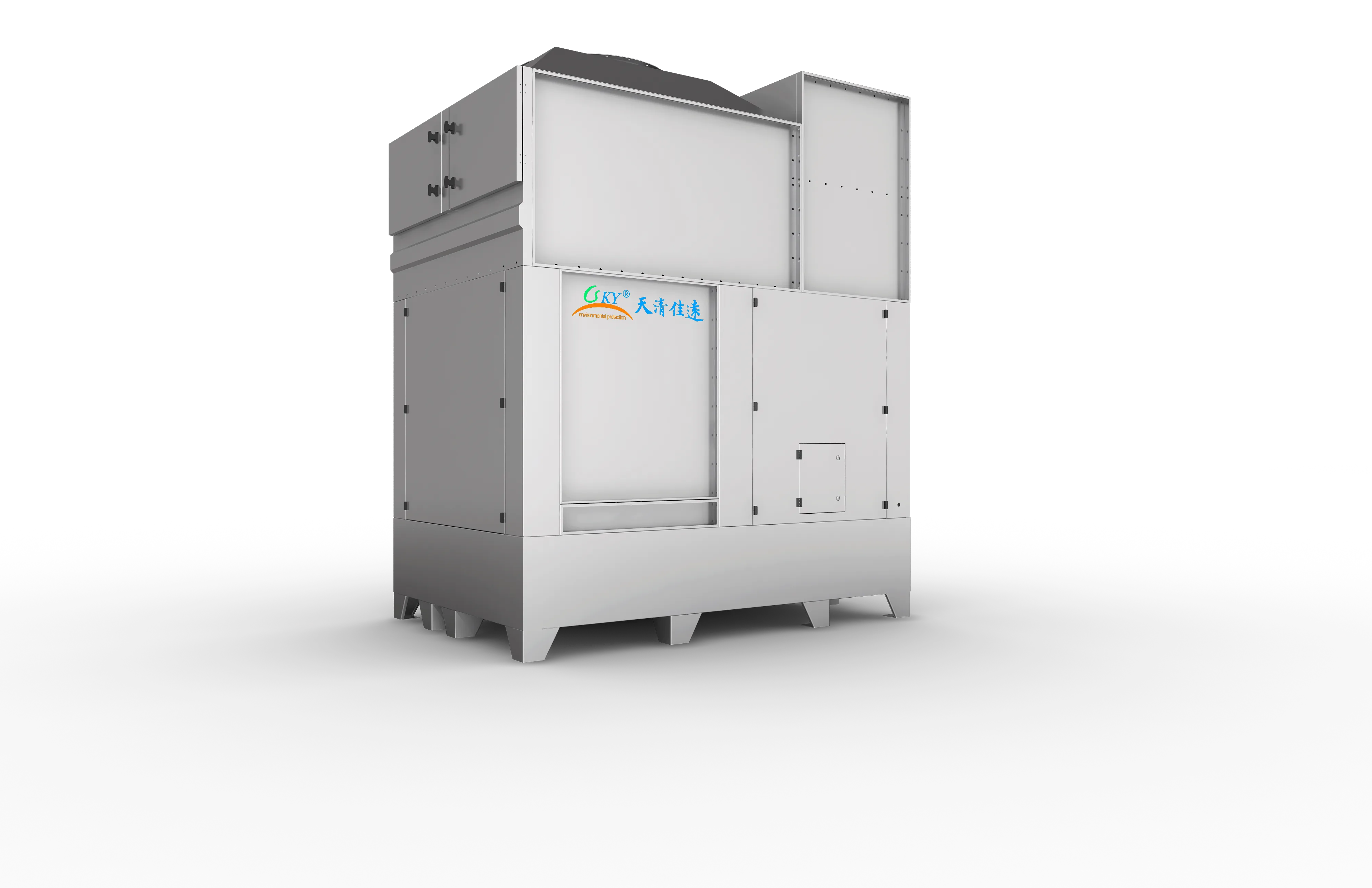
Jet Scrubber
A next-generation wet scrubber utilizing jet-ejection fluid dynamics to self-inhale process gases and generate intensive turbulent mixing, delivering acid-gas and dust removal efficiencies of >=95% with zero clogging.
Engineered Air Pollution Control for Automotive Component Finishing
From multi-solvent spray booth capture and high-boiling ester concentration to autothermal regenerative thermal oxidation — FluxFine delivers guaranteed compliance, CE/ISO certified metallurgy, and global turnkey execution.